Epic data architecture for governed analysis
Databasin extracts Epic Clarity, and Caboodle where your institution has implemented it, into a medallion lakehouse in your own Azure tenant or on the Databricks, Snowflake or Fabric you already run. Research, finance and operations teams query the prepared views through SQL and BI tools, or ask in plain English and get the SQL with the answer. We built it in production at WashU Medicine's Institute for Informatics, Data Science and Biostatistics (I2DB).
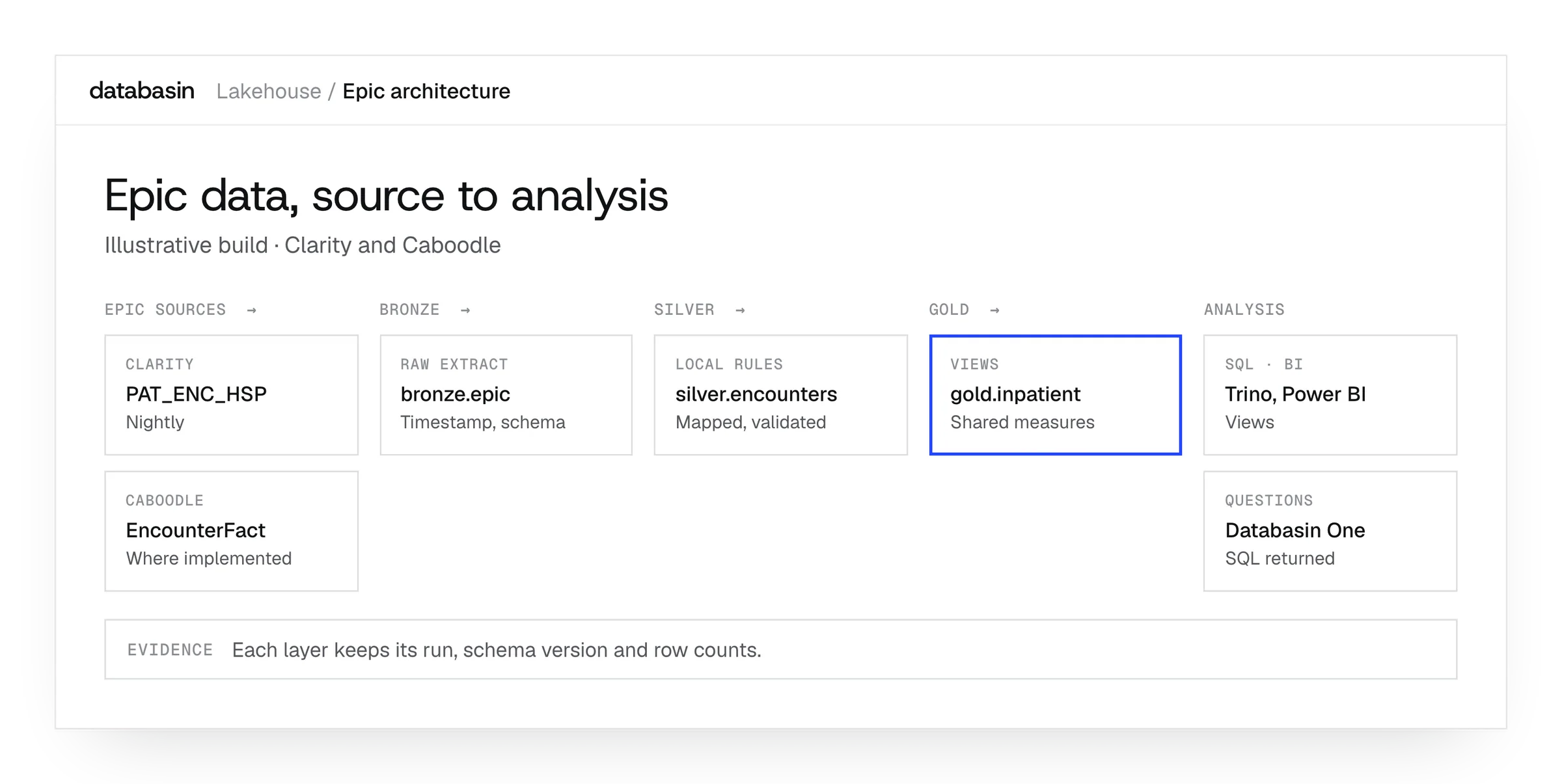





Source selection and refresh timing
Chronicles is Epic's live operational database. It is cache-based rather than relational, and analytical queries against it would compete with clinical work, so we never query it for analytics. Clarity is the relational reporting database, refreshed nightly from Chronicles. It holds the detail research, revenue cycle and operations analysis needs, and it is our primary extraction source.
Caboodle, Epic's star-schema warehouse, is used where your institution has implemented the subject areas a question needs; coverage differs between sites. FHIR APIs cover standard resources only, so they supplement Clarity for some fields but cannot replace it for bulk cohorts or revenue cycle work. Because Clarity refreshes nightly, the analysis states which day's data it reflects.
The layers behind Epic analysis
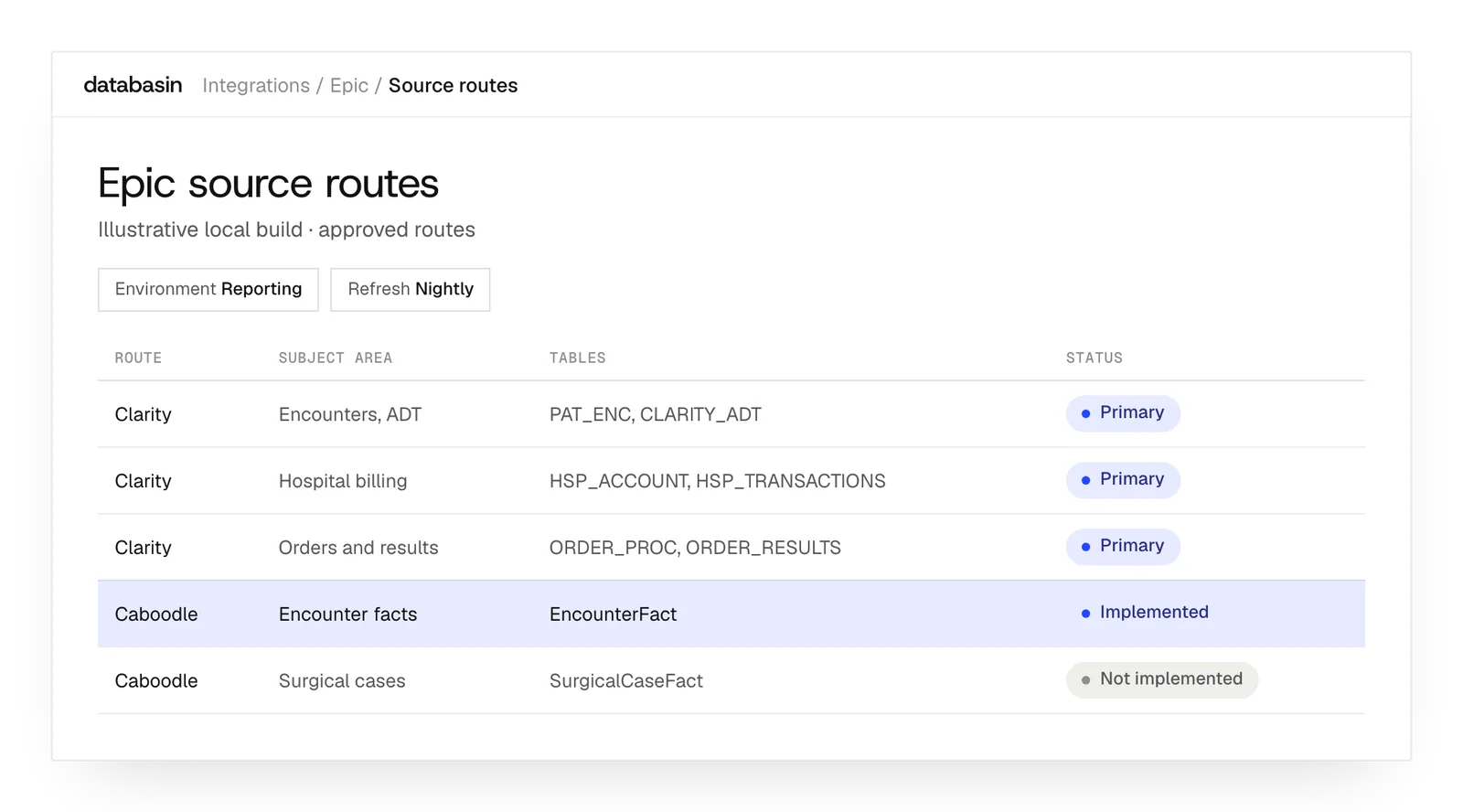
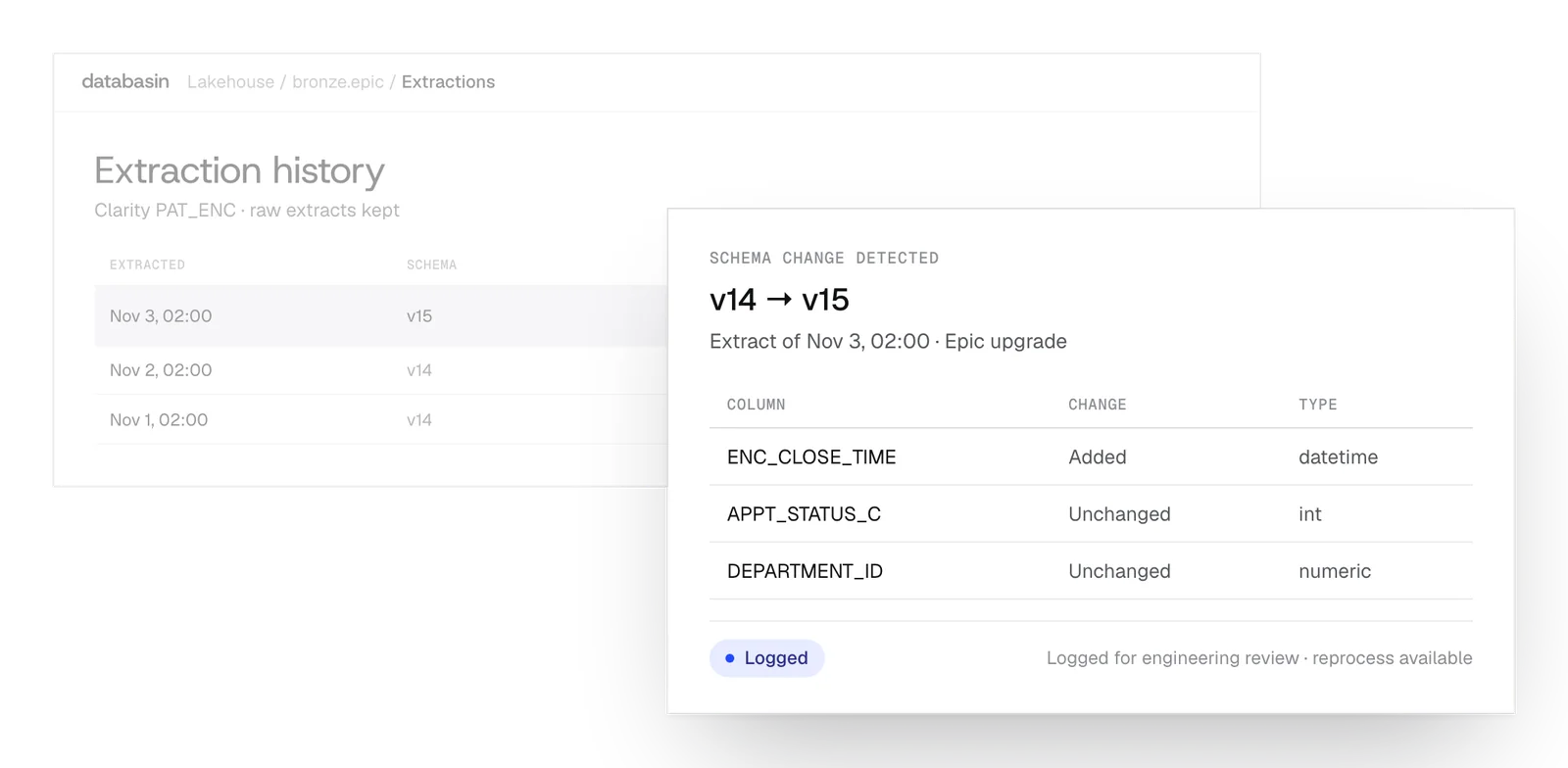
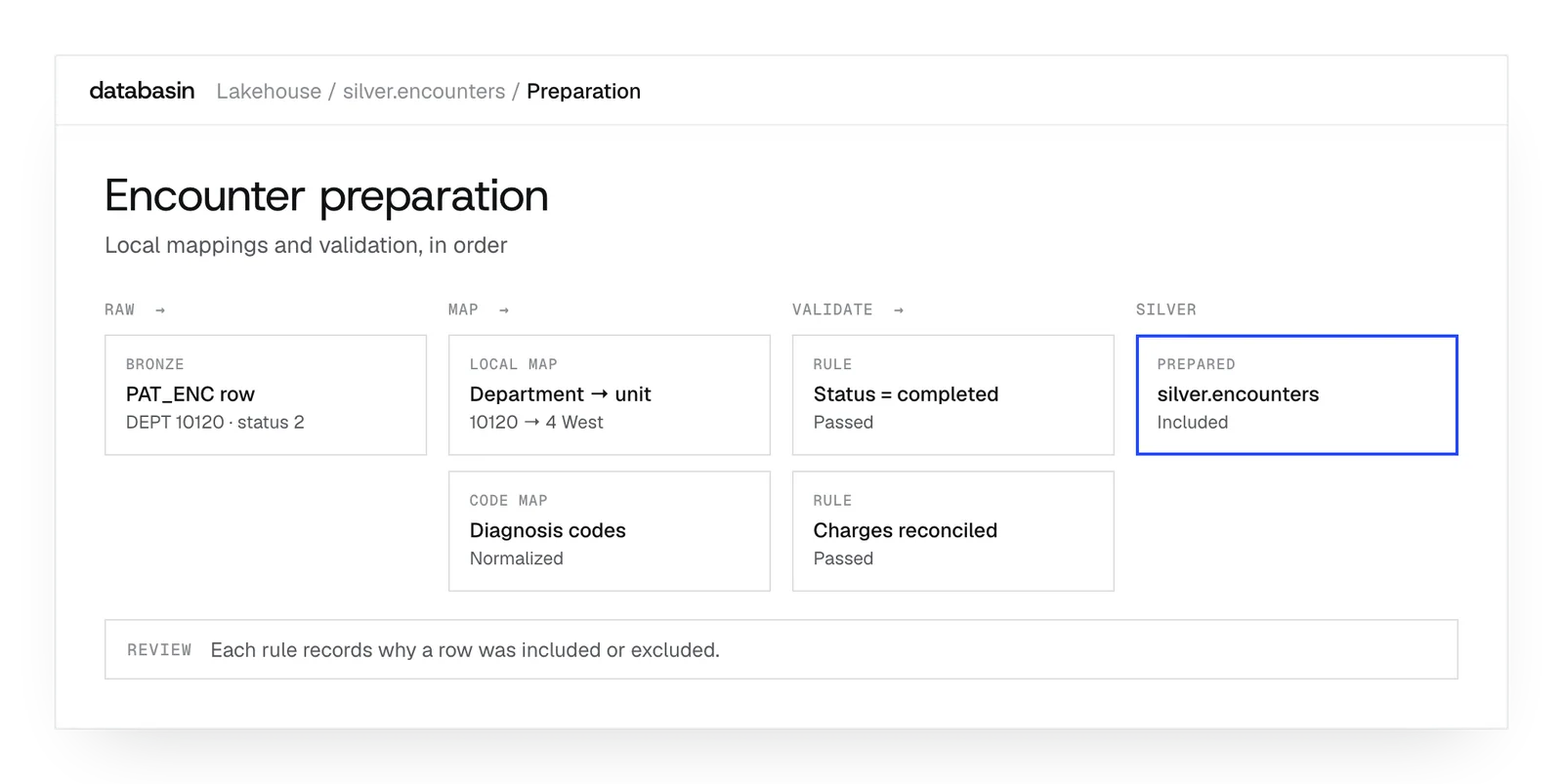
Controls for repeatable data preparation
Schema versions
Review the source schema recorded with the raw extraction being examined.
Extract timestamps
Check when a set of source records was captured for analysis.
Code normalization
Standardize source codes using the rules established for the analytical views.
Encounter filtering
Use the agreed encounter criteria when preparing records for a measure.
Financial reconciliation
Connect charge and payment records in preparation for shared financial measures.
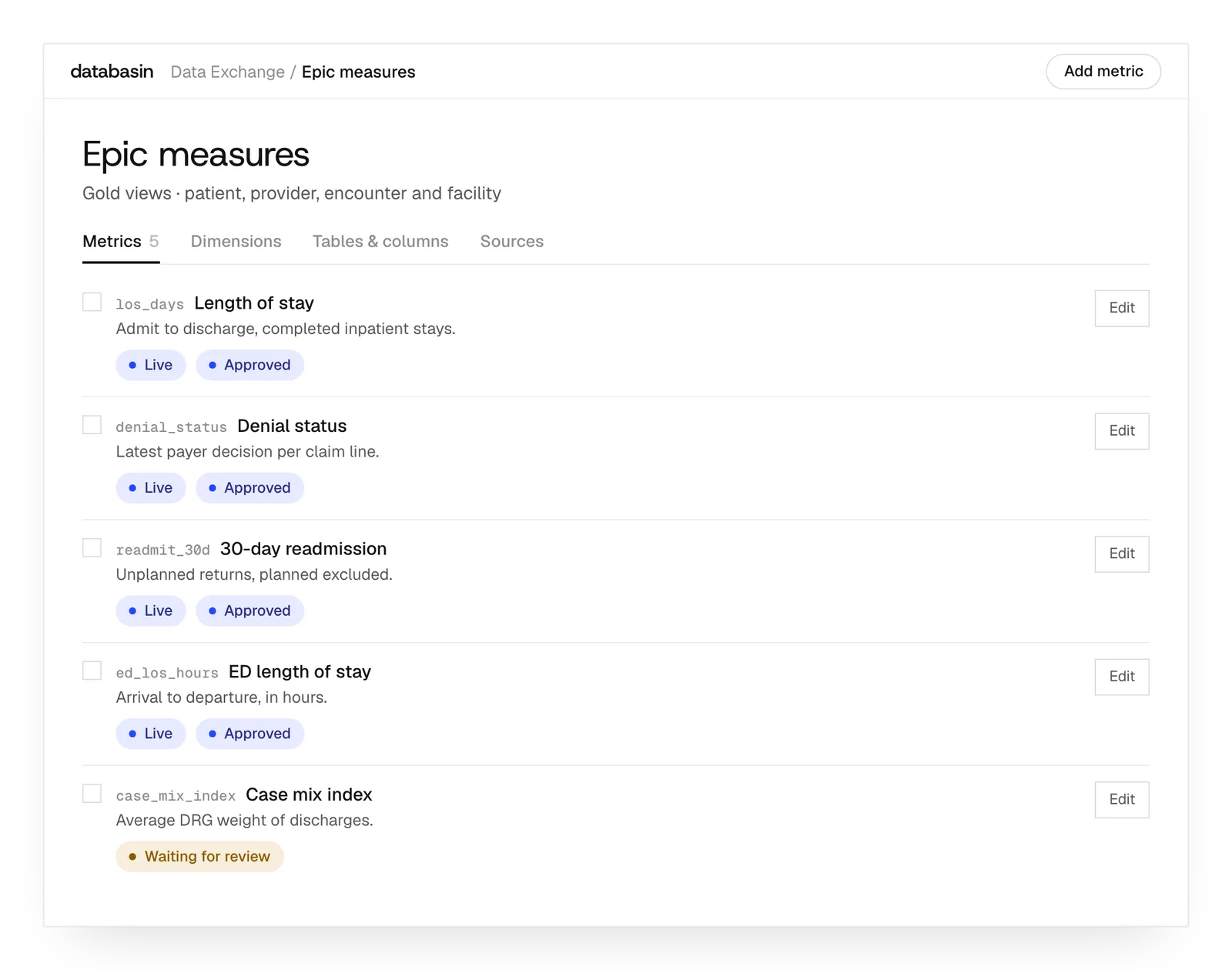
Documented measures
Examine the meaning and calculation behind a measure used by applications.
Examples of prepared Epic analysis
Research cohorts
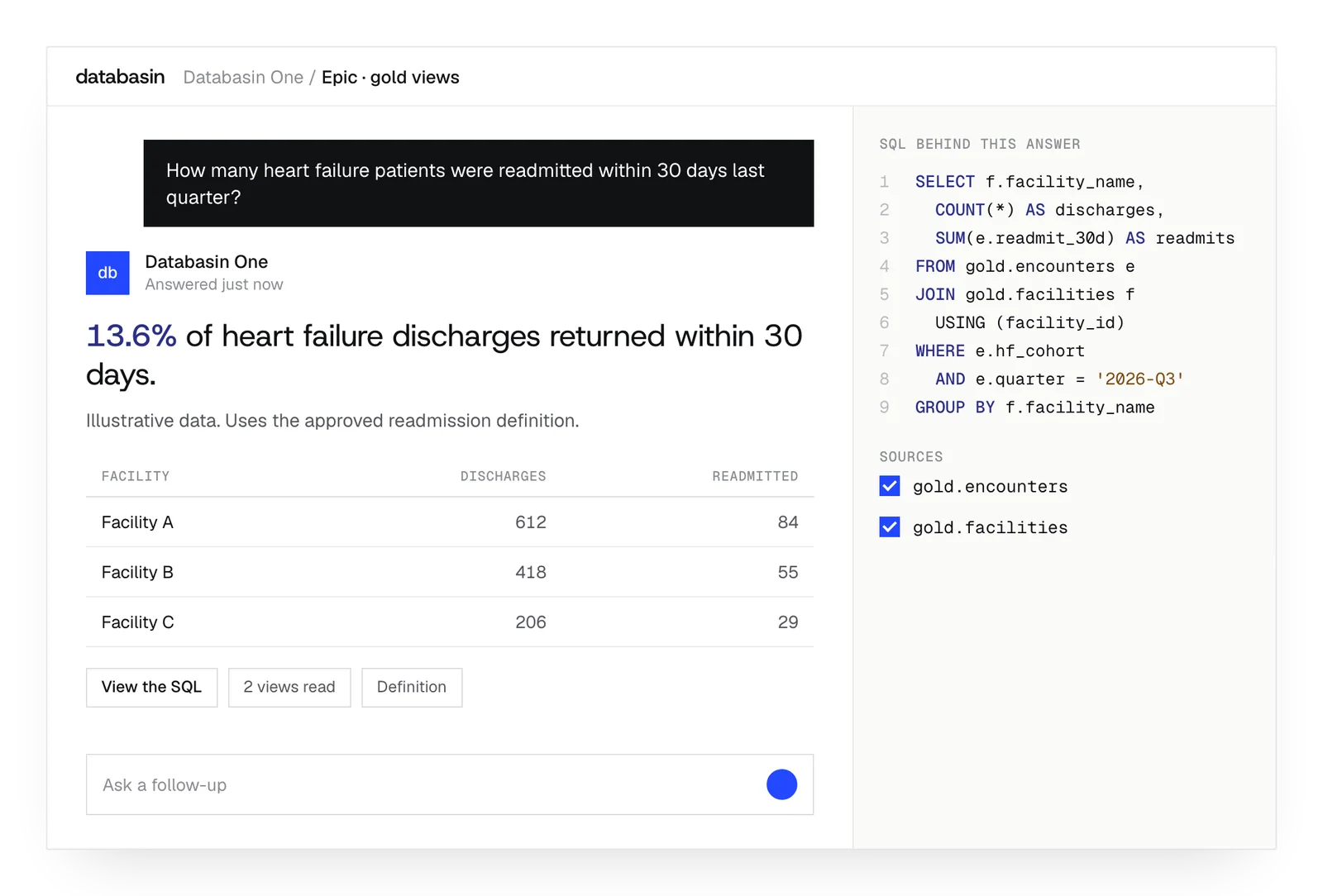
Researchers ask about a prepared cohort by unit and disposition and examine the query that produced the answer.
Revenue cycle
Finance follows charges, payments and denials through views built with the relationships and definitions needed for its review.
Clinical operations
Operations teams examine length of stay across facilities using the reporting period and encounter rules applied to the prepared data.
Deployment in your existing environment
Most academic medical centers and health systems install Databasin in their own Azure tenant from the Azure Marketplace. PHI never leaves your environment, and your Azure AD, RBAC and network policies apply. Teams already running Databricks, Snowflake or Fabric can use the Epic connector and medallion pipelines on that platform instead, without moving the lakehouse they have.
The language model runs behind your perimeter: GPT models through Azure OpenAI, Claude, or a model your institution hosts. No patient data is sent to an external AI service. Databasin is HIPAA-ready, with a BAA available. For a private installation, the design establishes the storage, network and model endpoints that the application will use.
With approved source access and the environment in place, governed Epic data can reach the lakehouse on day one. Our team implements the local mappings and measures for the application, then supports rollout. We work with the people who know the records to check their use in the intended analysis.
Security for business data
Databasin gives your team controls for who can use business data and records of how they use it.
Access
Your organization manages the identities people use to sign in. Data permissions apply to their work, and investigation agents have read-only access to production sources.
Regulated data
For work involving PHI or HR data, our team helps your security reviewers examine the requirements. Databasin is HIPAA-ready, with a BAA available.
Where data sits
You can use our hosted service, run Databasin in your own Azure tenant or use it alongside Databricks, Snowflake or Microsoft Fabric.
Audit
An answer comes with its SQL for review. Your team can also examine query logs and lineage to understand the data behind it.
What happens next
We would like to hear where your team wants to make progress with data and AI. We can discuss a project you have in mind or explore where Databasin could help with the work.
What happens next
Book a demo
Book a conversation about your organization and the work you want to improve. Questions about where to start are welcome.
Explore the opportunity
We show a working example that answers your business questions, then discuss what it would take to deliver it for your team.
Get the first result
After agreeing the first use case, we implement it with your team. We train the people using it and measure how it performs.
FAQ
Does the connector run analytical queries against Chronicles?
No. We extract from the reporting environments fed by Chronicles. Clarity supplies the primary route, and Caboodle can provide the required subject areas where they are available. Analytical queries use that reporting data.
Can standard FHIR resources cover a customized research dataset?
They may supply part of the dataset. Local fields in flowsheets or forms can require access through the reporting schema. We examine the requested fields before deciding where FHIR resources fit in the extraction.
What if Caboodle has only some of the subject areas we need?
We can use those subject areas and obtain the additional reporting records from Clarity. We inspect the available Caboodle implementation during design because coverage differs between institutions.
Can a query from another hospital be reused unchanged?
We review it against your local configuration first. Tables and fields can differ in their structure or meaning across institutions. The query must reflect the definition and local records used for the question at your site.
Where can engineers inspect a change after an Epic upgrade?
They can examine the schemas and versions captured with the bronze extraction. Those records show the structure used at that time. Engineers can identify affected transformations and reprocess the retained records after adapting them.
Where do local data-quality rules belong?
Silver is where we apply validation, standardization and institutional mappings. Gold uses those prepared records for analytical views. The transformation shows the rules that have been applied before the information reaches an application.
How is the AI endpoint chosen for a private installation?
The technical team and Databasin establish it during deployment design. Different providers and internally approved models are supported. The chosen endpoint, network and data route must match the institution's requirements for that installation.
Where was this Epic architecture built?
In production at Washington University School of Medicine's Institute for Informatics, Data Science and Biostatistics (I2DB). Epic data pipelines there were failing and research operations were at risk, and no commercial product handled Epic at academic medical center scale, so the team built one. It runs there today.
Who checks whether a clinical measure represents the intended population?
Our team and people familiar with the institutional measure review it together. They inspect the source records, calculation, exclusions and period. That connects the implemented result to the population the question is intended to describe.
Discuss the Epic architecture
We can explore how Epic reporting data would reach the applications your teams need. The conversation can cover source coverage, local mappings, deployment and the evidence analysts would use to inspect a result.