See everything. Ask anything.
Put it to work.
Databasin plugs into the tools you already run, answers questions in plain English, and puts agents on the work nobody wants to do by hand. Every number comes back with a receipt. Here's what that means in practice, and where to go deeper when you want the engineering.
Every source live in minutes, in one lakehouse you own.
New: live sources. Connect a supported tool or database and query it immediately, straight against the source. No sync required. Then one button builds the pipeline for anything you want to keep: schema mapped, schedule set, changes tracked, landing in one open Apache Iceberg lakehouse. For the 30 native sources, cleaned business-ready views come pre-built.
Your data arrives already modeled.
Most AI tools point a language model at a dump of your raw tables and hope it guesses right. Ours doesn't have to guess. Here is what actually happens.
-
1
You connect a source
Pick Salesforce, NetSuite, Sage Intacct, your SQL Server, or any of the 75+ others. Sign in, choose what you want, set a schedule. A few minutes, no engineer.
-
2
Databasin already knows its shape
Our team has already mapped each of these systems: which tables matter, what the fields mean, and how they join. That map ships inside the connector.
-
3
You ask a question
Your question runs against clean, business-ready tables instead of raw exports. That is why the answer comes back with a query you can read, and why it matches the number on your dashboard.
What about your custom fields?
The prebuilt map covers each vendor's standard setup. Anything custom you have added still lands on the first sync, and the AI helps you fold it into your models.
When a vendor changes their API
We change the connector, on our side, before it reaches you. Your pipelines keep running and your reports keep showing the same numbers. Nobody on your team gets a 2am page about a schema that moved.
Plain English in, cited answers out.
Databasin One turns your question into governed SQL and runs it against your gold layer — never raw tables. Back comes the chart, the narrative, and a link to the exact source behind every number. Trust it or check it. The receipt is always there.
Describe the job once and it runs forever.
A skill is the job written in plain English: what to look at, what counts as worth reporting, what to do about it. No code. Anyone on your team can write one, read one before running it, or copy and tune it. Drop it into your automations as a task and it works without you.
Every week, an agent reads the fresh numbers, writes the narrative, builds the charts, and ships the PDF to Slack before you're awake.
Nightly, an agent profiles your tables for nulls, duplicates, impossible values and staleness. The report it files is ranked by what will break reporting first.
Something moved? An agent traces which segment and which source, then shows you the query that proves it. You get an explanation, not just an alert.
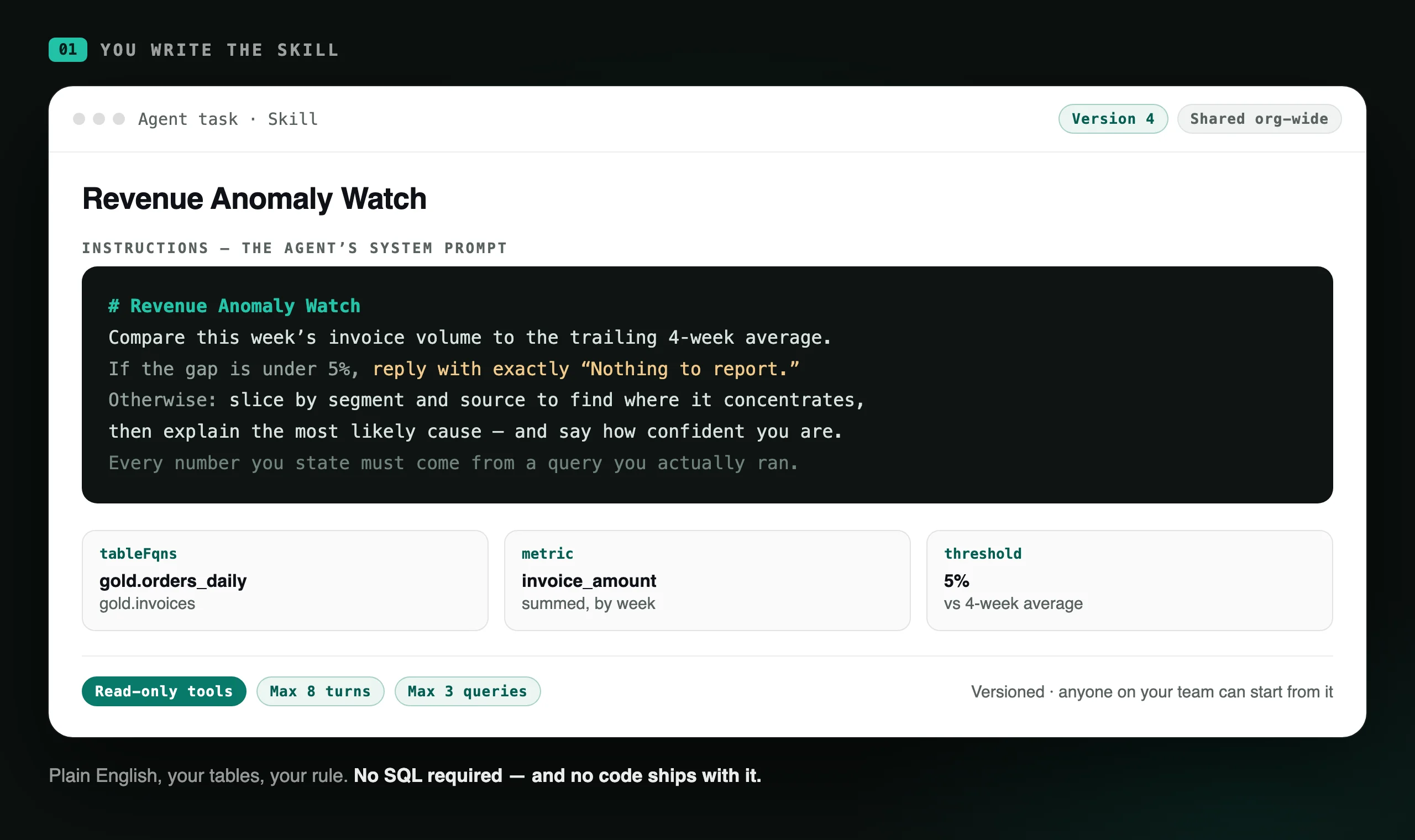
Every run is bounded and audited: read-only tools, a SELECT-only check on every query, a turn limit and a query budget you set. Afterwards you have a log of exactly what it read, what it ran, and what it produced.
From answer to artifact.
Any answer becomes a chart. Charts compose into live dashboards your team can explore. Polished documents generate straight from your data too: executive PDFs, spreadsheets, narrative summaries. Put any of it on a schedule and Delivery ships it to email, Slack, or Teams.
Contracts and PDFs, cited to the page.
Drop documents into your pipelines or straight into a chat. Databasin chunks and embeds them inside the platform; nothing leaves your environment. Answers come back with page-level citations, and clicking one opens the source with the passage highlighted.
A shared room for your team and your data.
Workspaces are persistent, shared spaces. Drop in files and everyone invited can query them straight away. Chats, dashboards, and documents stay with the room, and the AI sees the same context your team does. When you're ready, send results out to Slack or Teams behind a confirmation gate, so nothing leaves by surprise.
Two engines on one open lakehouse, with zero copies.
Everything above runs on the same foundation: your data in open Apache Iceberg tables, with Trino handling interactive SQL and federation while Apache Spark takes the heavy processing and ML. One catalog, no copies. Billing is per minute and stops when your cluster does. A single query can join synced gold tables, live sources, and federated databases. Sources, engines, agent skills and destinations plug in and swap out. Nothing is welded in.
Same platform. Two ways to run it.
The fastest start.
Fully hosted and fully managed, HIPAA-ready from day one. Sign up, click a connector, and you're querying in five minutes.
- Live in minutes, with nothing to deploy or patch
- Per-minute consumption pricing, every rate published
- $50 in credit, no card required
Your tenant. Your posture.
Install from the Azure Marketplace and the whole platform runs inside your own tenant, on your network, under your policies, with your keys.
- Data never leaves your tenant
- Unlimited seats for the whole organization
- Your compute and your LLM, paid to Azure directly with no markup
Already committed to Databricks, Snowflake, or Fabric? BYO mode layers Databasin's connectors, automations, governance, and AI on top of the platform you have. It adds what's missing without displacing what works.
Everything above. One free workspace.
Just your email. We'll build your workspace and send your sign-in link.
Plug in. Ask. Put it to work.
$50 credit · No card · First answer in 5 minutes. Or talk to us about a bigger footprint.