Data and AI for academic medicine
Databasin helps academic medical centers use clinical, workforce and research data to answer questions and automate recurring work. For AAMC visitors, we can show how that work connects across an institution. Our team implements the platform, builds the applications and helps people use them in daily decisions.





Connected clinical and institutional work
Databasin began at Washington University School of Medicine, where it was co-created and remains in production. The work connected clinical and institutional information for people who needed to analyze it together.
Other academic medical centers face questions across the same kinds of sources: Epic records, Workday finance and HR, and research systems. We connect the required records and prepare the definitions behind the answer. Researchers, administrators and finance staff can use that preparation when investigating a question across departments.
Applications across the medical center
Research analysis
We connect approved Epic and research data for institutional questions that researchers can investigate by asking in plain language.
Workforce and finance
We prepare Workday assignments and financial measures for a common reporting period, giving departments a basis for comparison.
Operational reviews
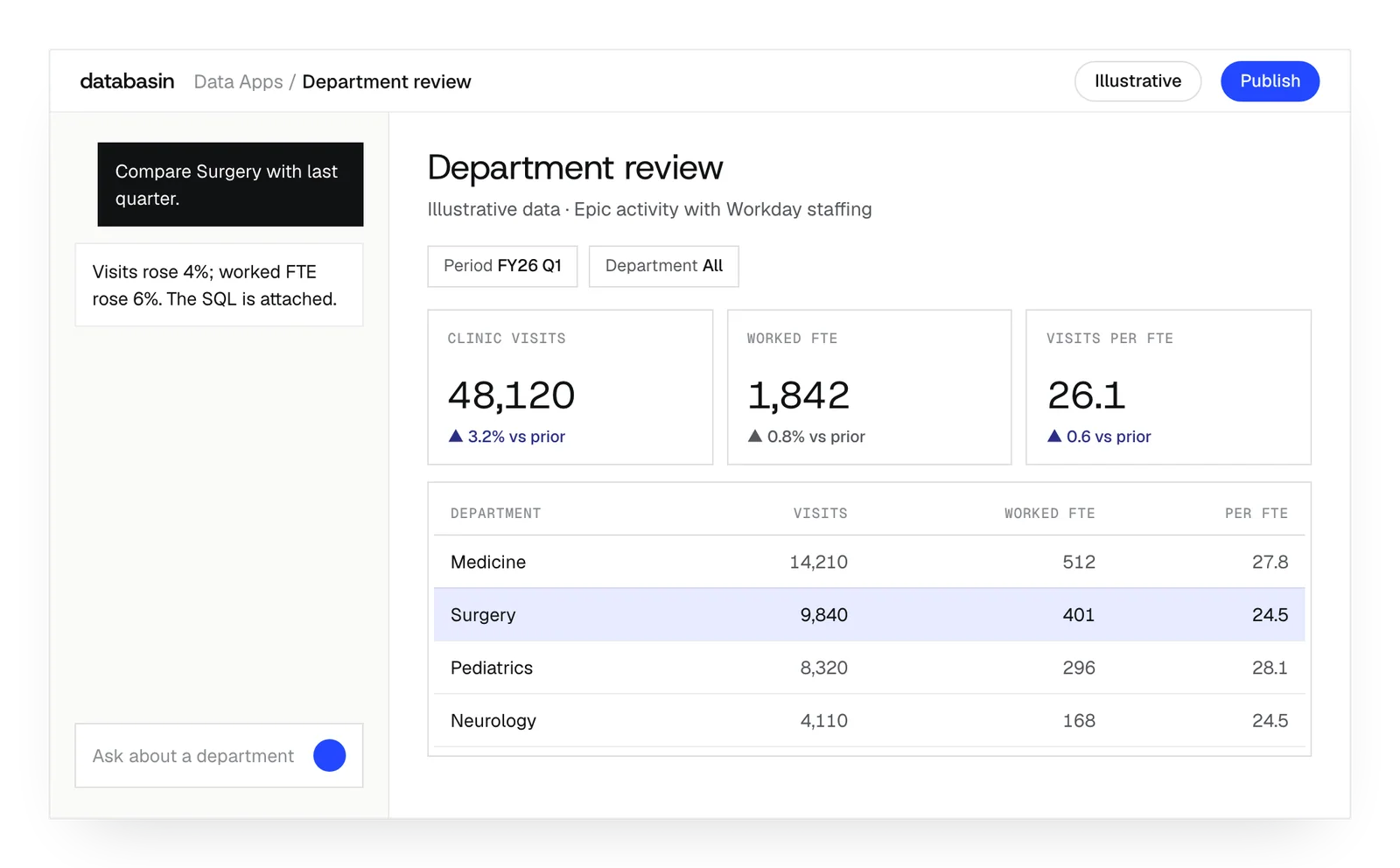
We schedule data preparation and build Data Apps around the measures administrators revisit when reviewing departmental performance.
How do teams investigate together?
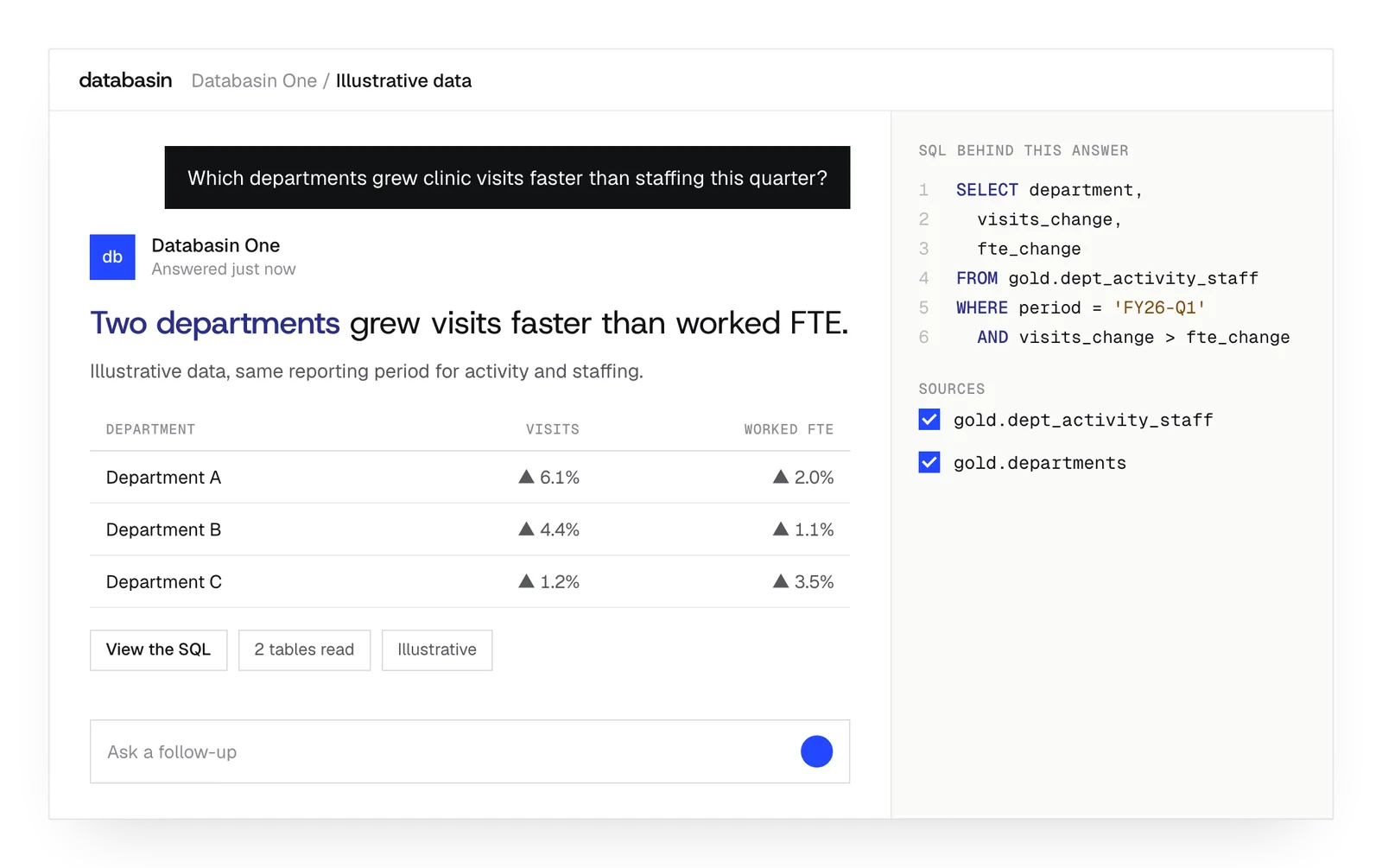
A person can ask Databasin One about a departmental measure, then open the SQL behind the answer. A Data App can present those same definitions for a shared review.
Consider a department examining clinical activity alongside staffing in one reporting period. We connect the records needed for that comparison. Colleagues can investigate the figures together and see how the query calculated them.
Delivery through the first working use
Our team implements the connections, definitions and applications for the improvement your institution wants to make. We work through the local source mappings and access design, then include communication, rollout and training in the build.
The first use case goes live in 90 days. After launch, we can run it for you, provide monthly support hours or stay on call. Epic data services explains the source work; health systems shows how different teams can use the result.
What happens next
We would like to hear where your team wants to make progress with data and AI. We can discuss a project you have in mind or explore where Databasin could help with the work.
What happens next
Book a demo
Book a conversation about your organization and the work you want to improve. Questions about where to start are welcome.
Explore the opportunity
We show a working example that answers your business questions, then discuss what it would take to deliver it for your team.
Get the first result
After agreeing the first use case, we implement it with your team. We train the people using it and measure how it performs.
FAQ
Is this only for research departments?
No. A finance, HR or operations team can also begin a project. Its question may stay within the department or require clinical and institutional records from several sources.
Can an AMC start without Caboodle?
Yes. Clarity provides a starting source for reporting. We examine the local Epic build and measures to determine what the application needs beyond those records.
Will the analysis show today's clinical events?
Clarity reporting usually follows a nightly refresh. The application therefore shows the records available for that reporting period; we account for this timing in its design.
Can research access differ from finance access?
Yes. Roles can have access to different records. We establish the permitted scope for the application so the platform can support both teams without giving everyone identical access.
Can we include REDCap information?
Yes. REDCap can provide research records alongside permitted clinical and institutional data. We prepare the relationships that let the application use those records together.
How are earlier staffing assignments represented?
The effective date in Workday tells us when an assignment applied. Historical analysis uses those assignments for the selected period, including the department and staffing context at that time.
Can Databasin run in our Azure tenant?
Yes. We can install Databasin Private in the institution’s Azure environment. Technical and security reviewers work with us on the identity, network and data access configuration.
Do we have to replace an existing warehouse?
No. Databricks, Snowflake or Microsoft Fabric can remain part of the environment. We plan the application around the platform your institution intends to use.
Can analysts continue using SQL?
Yes. Analysts can write queries over the prepared records. They can also inspect the SQL returned by Databasin One to examine the calculations business users are discussing.
Can the project include an existing reporting process?
Yes. We examine how the report is prepared and used, then implement its data work and application. The build includes training and rollout for the people using it.
Discuss data work at your institution
Talk with us about the questions your departments need to answer and the work that repeats around them. We can explore how Databasin could help, whether you have a project in mind or are considering where to begin.